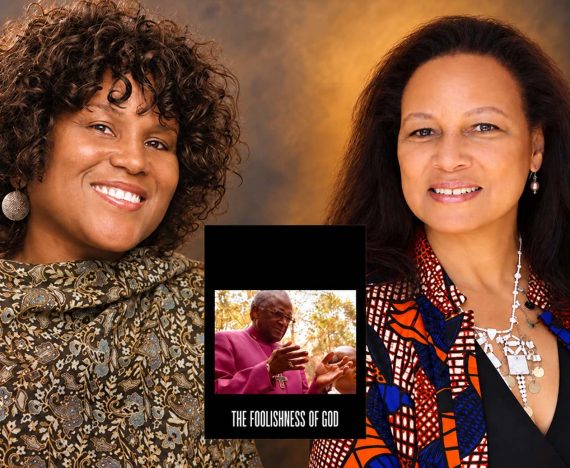
Can justice and forgiveness exist in the same space after unimaginable suffering? That profound question sits at the heart of The Foolishness of God: A Forgiveness Journey with Desmond Tutu, an intimate documentary chronicling filmmaker Karen Hayes’ extraordinary 15-year journey alongside Nobel Peace Prize laureate Archbishop Desmond Tutu.
The documentary opened the 16th Festival International des Films de la Diaspora Africaine (FIFDA Paris) on September 4, 2026, at Cinéma CGR Paris Lilas, bringing a deeply personal examination of justice, reconciliation, accountability and healing to an international audience.
Hayes was joined by co-producer and story editor Rana Kazkaz for the opening and post-screening conversation.
The occasion also highlighted the work of Emmy Award-winning producer and executive producer Sandra Evers-Manly, founder and president of the Black Hollywood Education and Resource Center (BHERC), whose decades of advocacy have helped expand opportunities for diverse filmmakers and preserve important stories in film and television.
A 15-Year Journey With Desmond Tutu
The documentary follows Hayes as she accompanies Archbishop Tutu through more than 15 years of defining historical moments.
The journey begins around South Africa’s first democratic election and eventually moves through the devastating aftermath of the Rwandan genocide, South Africa’s Truth and Reconciliation Commission and reconciliation initiatives in the Solomon Islands.
Hayes initially believed she was making a documentary primarily about justice.
Her perspective changed dramatically in Rwanda.
After witnessing the emotional impact of a massacre site, Hayes watched as Tutu met with imprisoned perpetrators and challenged survivors to consider the possibility of forgiveness.
That experience forced the filmmaker to confront an enormously difficult question: Does forgiveness complement accountability, or can asking victims to forgive place another burden upon people who have already suffered enough?
According to Hayes, Tutu’s intention was ultimately to challenge the world to consider whether even seemingly unforgivable acts could be confronted through forgiveness.
Five Key Elements of the Documentary
The film reaches beyond a traditional biographical portrait of Desmond Tutu. Among its central themes are:
- Justice and accountability: The documentary examines whether societies can demand accountability while simultaneously pursuing reconciliation.
- Forgiveness after tragedy: Hayes explores what forgiveness means for survivors and whether it can become a tool for reclaiming personal dignity.
- Rare historical perspectives: Footage and encounters spanning South Africa, Rwanda and the Solomon Islands connect Tutu’s philosophy with real-world conflicts and reconciliation efforts.
- A filmmaker’s personal transformation: Hayes moves from observing Tutu’s work to confronting unresolved experiences within her own family.
- The human side of Desmond Tutu: The film includes Tutu’s reflections on his own life, including regret surrounding his relationship with his father.
Together, these elements transform the project from historical documentation into an intensely human exploration of what happens after violence, injustice and loss.
Sandra Evers-Manly Champions Storytelling
Behind the film is another significant story: the continued work of Sandra Evers-Manly to create opportunities for filmmakers and ensure historically overlooked perspectives reach audiences.
Evers-Manly founded BHERC in 1996 with a mission centered on advocacy, education, development and preservation of Black images and voices throughout film and television.
She described Hayes’ documentary as courageous work shaped by the filmmaker’s experiences as a woman, activist and storyteller.
For more than three decades, Evers-Manly’s work through BHERC has included filmmaker showcases, festivals, mentoring, scholarships and career-development programs for young people.
She is also an executive producer of A Better Way: James Lawson, Architect of Nonviolence, another Hayes documentary examining the life and legacy of civil-rights leader James Lawson and the use of nonviolence as an instrument for social change.
Karen Hayes Turns the Camera Inward
Hayes brings both filmmaking experience and activism to the project.
A graduate of UCLA with an M.F.A. in Film and Television Production, she is also an alumna of Tribeca All Access and the American Film Institute Directing Workshop for Women.
Through Ubuntu Motion Pictures, Hayes develops projects intended to educate audiences, inspire conversation and explore justice and healing.
But The Foolishness of God eventually required Hayes to become more than an observer.
As the documentary develops, Tutu’s philosophy forces her to consider unresolved pain within her own family. Meanwhile, Tutu acknowledges his own regret about never reconciling with his father.
That parallel gives the documentary an intimate dimension. Forgiveness is no longer treated only as a political or historical concept—it becomes personal.
Rana Kazkaz Brings a Global Perspective
Co-producer and story editor Rana Kazkaz adds another international filmmaking perspective.
Kazkaz is an award-winning filmmaker and Northwestern University Qatar professor whose work has appeared at major international festivals, including Cannes, Sundance, Toronto, Tribeca and Tallinn.
Her involvement helps strengthen a story already crossing countries, cultures and generations.
The Paris discussion between Kazkaz and Hayes offered audiences an opportunity to examine both the documentary’s creative process and the broader relevance of reconciliation in a world still confronting conflict and division.
FIFDA Paris Creates a Global Platform
Founded in Paris in 2009, the Festival International des Films de la Diaspora Africaine showcases independent cinema connected to Africa and the global African diaspora.
Its 16th edition presented 15 films representing 13 countries and territories from September 4–6, 2026.
Opening the festival with The Foolishness of God placed questions about justice, memory, history and humanity at the center of the festival conversation.
When Forgiveness Becomes Power
Perhaps the documentary’s most compelling idea is that forgiveness does not necessarily require forgetting history or excusing injustice.
Instead, it asks whether forgiveness can sometimes allow individuals and communities to reclaim control from experiences that have caused tremendous pain.
That question has no simple answer—and the documentary doesn’t pretend that it does.
Through Hayes’ eyes and Tutu’s philosophy, audiences are invited to consider whether truth, justice, accountability and forgiveness can coexist without diminishing one another.
More than a portrait of an internationally recognized moral leader, The Foolishness of God becomes a meditation on humanity itself—and on what it may take to stop trauma and violence from passing from one generation to the next.
Festival Information & Tickets:
FIFDA.org
Written by Mark Winkler